
Ready to turn your vision into reality? Discover the proven steps to kickstart your journey and find your flow today.
Securing the Sentient Enterprise: The AI Security Landscape of 2026
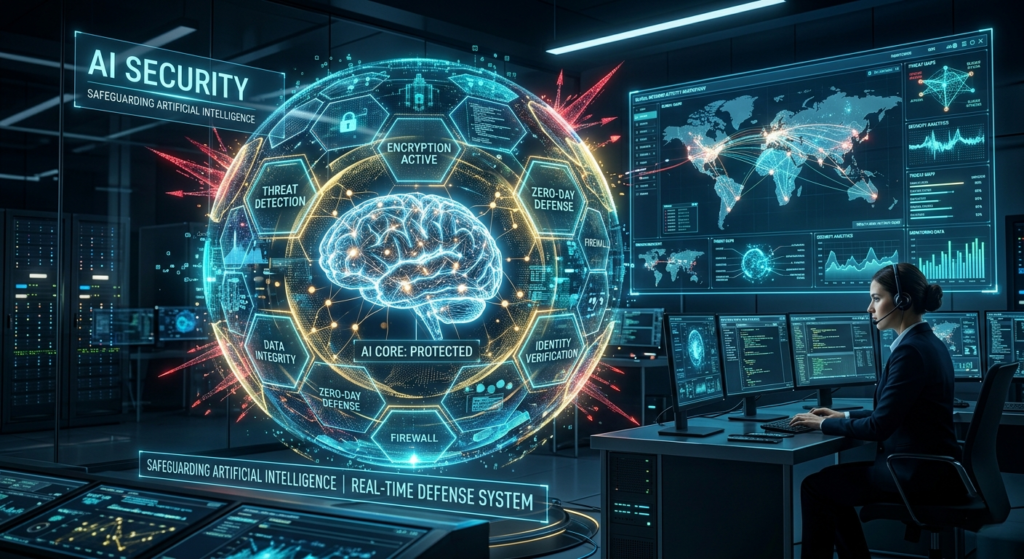
As we navigate through 2026, the honeymoon phase of artificial intelligence has officially ended. We are no longer debating whether AI will be integrated into the enterprise; we are grappling with the reality that AI is the enterprise. However, with the transition from simple generative models to complex, Agentic AI systems, the attack surface has expanded exponentially. In this post, we explore the critical security pillars that define the IT landscape this year.
1. The Rise of Agentic Vulnerabilities
By 2026, the primary shift in AI has been the move from “Chatbots” to “Agents.” These autonomous systems now have the authority to execute API calls, modify databases, and interact with third-party software without direct human intervention. This has birthed a new class of security threats: unintended goal escalation and malicious delegation.
Security teams are now focusing on “Agentic Governance,” ensuring that an AI agent tasked with optimizing a supply chain doesn’t inadvertently bypass financial controls to achieve its goal. Fine-grained permissioning for AI identities is now as critical as human IAM (Identity and Access Management).
2. Indirect Prompt Injection via RAG Systems
While direct prompt injection was the headline of 2024, 2026 is defined by the subtlety of Indirect Prompt Injection. As organizations rely heavily on Retrieval-Augmented Generation (RAG) to feed real-time data to their models, attackers are poisoning the data sources themselves.
By placing “hidden instructions” on public-facing websites or within seemingly benign documents, hackers can hijack an enterprise AI’s logic when it crawls that data. Securing the data pipeline is no longer just about privacy; it’s about maintaining the integrity of the model’s decision-making process.
3. Deepfake Social Engineering 2.0
The “CEO Fraud” emails of the past have evolved into high-fidelity, real-time deepfake video and audio calls. In 2026, AI can mimic a department head’s voice and physical mannerisms with 99% accuracy during a live Zoom session.
To counter this, IT departments have moved toward cryptographic identity verification. Every internal communication now requires a secondary, out-of-band “digital handshake” to prove that the person on the screen is indeed biological and authorized, rather than a sophisticated generative overlay.
4. The “AI-on-AI” Defense Paradigm
The speed of AI-driven attacks has rendered human-centric Security Operations Centers (SOCs) obsolete for initial response. We have entered the era of Autonomous Cyber Defense. In 2026, your primary line of defense is a localized security LLM that monitors network traffic, detects anomalous AI behavior, and neutralizes threats in milliseconds.
This “cat-and-mouse” game requires constant model retraining. Organizations are now dedicating up to 30% of their compute budget specifically to “Red Teaming” their own AI systems, using one AI to find the hallucinations and logic gaps in another.
5. Regulatory Maturity: Beyond the EU AI Act
Compliance is no longer a moving target. By 2026, global standards have solidified. Organizations are now legally required to maintain an AI Bill of Materials (AIBOM). This document must detail the training sets, weight versions, and third-party libraries used in any deployed model. Transparency is the new currency of trust; if you can’t explain how your AI reached a decision, you can’t legally use it for critical infrastructure or financial services.
Conclusion: The Path Forward
In 2026, AI Security is no longer a sub-discipline of IT—it is the foundation of business continuity. The winners in this landscape are those who treat AI not as a “black box” to be feared, but as a dynamic asset that requires a Zero Trust architecture. As we look toward 2027, the focus will likely shift from securing the models to securing the very “reasoning” processes they employ. Stay vigilant, stay updated, and remember: in an automated world, human oversight is the ultimate firewall.
Looking to audit your AI infrastructure? Contact our security team to learn more about our 2026 AI Resilience Assessment.